" height="1px" id="SmV0VUGmc" transform="translate(36.666 22.49)" width="1px"/><path d="M 0 0.006 C 0.004 0.119 0.01 0.234 0.017 0.343 L 0.017 0 Z" fill="rgb(255, 255, 255)" height="1px" id="IwBsPIGqr" transform="translate(36.666 22.49)" width="1px"/><path d="M 62.999 22.791 C 62.999 24.622 62.503 26.231 61.515 27.626 C 60.527 29.021 59.056 30.1 57.095 30.859 C 55.134 31.621 52.718 32 49.848 32 C 47.842 32 46.042 31.805 44.453 31.419 C 42.864 31.03 41.498 30.45 40.358 29.674 C 39.215 28.899 38.325 27.906 37.695 26.695 C 37.107 25.574 36.766 24.291 36.668 22.846 L 36.668 22.503 L 36.651 22.509 C 36.654 22.622 36.661 22.737 36.668 22.846 L 36.668 31.347 L 30.419 31.347 L 30.79 7.441 L 30.327 7.441 L 21.063 31.347 L 15.416 31.347 L 6.294 7.441 L 5.831 7.441 L 6.202 31.347 L 0 31.347 L 0 0.65 L 9.998 0.65 L 18.52 23.766 L 18.75 23.766 L 27.133 0.65 L 36.668 0.65 L 36.668 16.655 C 36.668 19.161 34.111 18.911 34.111 18.911 L 34.111 20.649 L 42.533 20.649 C 42.533 22.044 42.865 23.209 43.528 24.139 C 44.192 25.07 45.104 25.759 46.261 26.208 C 47.42 26.659 48.723 26.884 50.175 26.884 C 51.627 26.884 52.742 26.706 53.715 26.35 C 54.689 25.994 55.422 25.528 55.915 24.955 C 56.407 24.381 56.657 23.737 56.657 23.022 C 56.657 22.25 56.338 21.613 55.707 21.116 C 55.074 20.621 54.233 20.202 53.182 19.862 C 52.135 19.519 50.913 19.196 49.524 18.885 C 48.014 18.512 46.523 18.117 45.058 17.698 C 43.591 17.279 42.264 16.728 41.075 16.045 C 39.886 15.366 38.944 14.481 38.251 13.396 C 37.555 12.311 37.211 10.929 37.211 9.256 C 37.211 7.396 37.686 5.783 38.645 4.417 C 39.601 3.055 40.973 1.976 42.767 1.185 C 44.556 0.397 46.746 0 49.34 0 C 51.934 0 54.154 0.38 56.006 1.138 C 57.858 1.9 59.287 2.969 60.291 4.347 C 61.293 5.73 61.841 7.349 61.934 9.209 L 61.934 10.846 L 55.96 10.882 C 55.96 9.951 55.799 9.13 55.475 8.418 C 55.153 7.705 54.713 7.102 54.154 6.603 C 53.599 6.109 52.913 5.743 52.095 5.512 C 51.278 5.278 50.342 5.162 49.294 5.162 C 48.09 5.162 47.042 5.317 46.145 5.627 C 45.249 5.937 44.585 6.356 44.155 6.883 C 43.721 7.411 43.505 8.031 43.505 8.744 C 43.505 9.578 43.846 10.271 44.526 10.812 C 45.202 11.356 46.128 11.798 47.304 12.138 C 48.476 12.481 49.74 12.821 51.1 13.161 C 52.427 13.411 53.786 13.744 55.175 14.161 C 56.564 14.579 57.858 15.124 59.063 15.79 C 60.268 16.456 61.223 17.357 61.933 18.488 C 62.642 19.62 63 21.054 63 22.79 Z" fill="rgb(255, 255, 255)" height="32px" id="AJLABMoVF" width="63px"/></g></svg>)
Design System
Design Tokens
Figma
Fintech
Northbound
A 156-Token Naming Grammar for a Cross-Border Investing App
Project Overview
A token-driven, Figma-only design system foundation for a concept investing app serving non-US investors accessing US markets, built to prove that a naming grammar can scale past three screens without a single renamed token.
Client
Concept Product
Services
Design Systems
Role
Design System Specialist
Date
The Challenge
Most Figma-only design systems are a UI kit with no system underneath: named color styles with no traceable link back to a raw value, no way to prove a fill isn’t just an eyeballed match. That gap disappears on one screen and becomes obvious the moment a product needs two themes, six feedback purposes, and a currency conversion screen where the same red has to mean two different things in two different places. Northbound, a concept investing app for non-US investors moving into US stocks and ETFs, was built to put exactly that pressure on a token system: currency duality and FX transparency don’t forgive decoration dressed up as architecture.
The Approach
The foundation is a set of raw color primitives, gray, gold, blue, red, orange, green, with gold kept as its own hue family so brand and warning never blur together. A semantic layer of 156 tokens sits on top, naming intent instead of color through one fixed grammar: category, purpose, emphasis, state. Each token points back to a primitive by alias, not a flattened value, so the grammar is inspectable, not decorative. That same layer drives both themes: light and dark share identical token names with different values underneath, so a theme switch is a value swap, not a redesign. Components are organized into four levels, Foundation, Composite, Feature, Layout, each built only from the level below it, which gives the FX work its own named tier instead of a generic components pile.

Key Decisions & Trade-offs
The gold ramp skips steps 200 to 400, the range a dark-theme hover state would pull from. It’s left unfilled on purpose: nothing breaks today, and adding speculative steps for a state that doesn’t exist yet is just more surface to maintain. The bigger trade-off is scale over scope: the semantic layer stayed at its full 156 tokens rather than trimming to what three screens actually use. That’s a bet that a system built at product scale, even partially exercised, proves scalability better than one trimmed to fit the demo.
The Solution
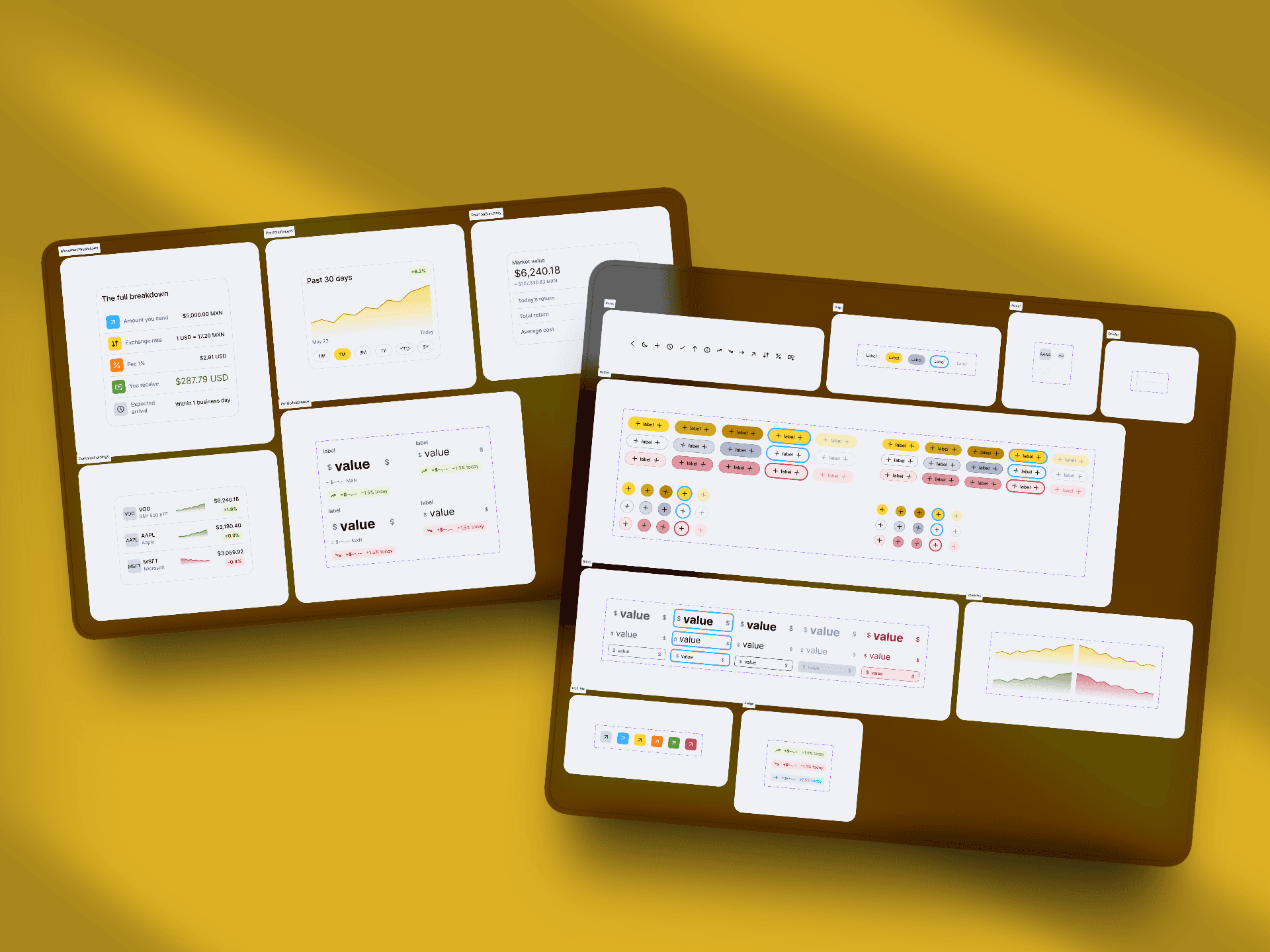
The file holds three screens built entirely from the token system: Portfolio Dashboard, Asset Detail, and Deposit and FX Conversion, the last one carrying the app’s real differentiator, a full breakdown of amount sent, exchange rate, fee, and amount received in both currencies. Underneath sits a 25-component library across four levels: 9 Foundation (Button, Input, Icon, Avatar, Divider, Chip, Badge, Icon Tile, Sparkline), 7 Composite (Card, Data Row, Chip Group, Amount Cluster, Asset Header, Section Header, Holding Row), 5 Feature (Movement Breakdown, Price Chart, Position Summary, Personal Holdings, Portfolio Balance), and 4 Layout (AppBar, BalanceSection, HoldingsSection, ScreenScaffold). Every component exists in both light and dark, driven by the same tokens, so the two themes are the same file read against a different value set.
The Impact
156 semantic tokens across four categories: 52 background, 32 text, 44 border, 28 icon
Light and dark token sets are name-identical, so no component needs to know which theme it’s in
25 components across four levels: 9 Foundation, 7 Composite, 5 Feature, 4 Layout
3 screens built entirely from the token and component system
Brand anchor, gold.500 on gray.900, checks at 13:1 contrast, AAA

What’s Next
This is a concept product: no real money moves, all data is sample data, every number exists to stress-test the system, not to advise anyone. What’s documented here is the token architecture and component library, verified in Figma, stopping deliberately at that boundary. The naming grammar was built to carry over without renaming a token, and proving that, tokens compiled, components rebuilt, an AI pipeline generating code straight from this file, is Northbound’s second case study: Code-Ready Design System and GitHub Repo. Same system, one boundary further.
" height="32.000000232536706px" id="NzcNya2r3" width="193px"/><path d="M 0 0.997 L 0 0 L 33.065 0 L 33.065 0.997 Z" fill="rgb(255, 255, 255)" height="1px" id="tBQtjocvX" transform="translate(115.864 28.706)" width="33.064500157592704px"/><path d="M 0 0.997 L 0 0 L 33.065 0 L 33.065 0.997 Z" fill="rgb(255, 255, 255)" height="1px" id="khcxy1dV6" transform="translate(44.183 28.706)" width="33.06450015759276px"/></g></svg>)